


Opens in a new tab
Software Training Institute in Chennai with 100% Placements – SLA Institute

Data Science Course with Lifelong Placement Assistance

duration
3-4 Months
EMI
0% Interest
Mode
Online & Offline

Build job-ready Data Science skills with SLA Institute through an AI-powered curriculum, practical training, and career-focused learning designed to help you advance in the IT industry.

  • 100% AI-Powered Syllabus
  • Hands-On Training & Real-Time Projects
  • Global Certifications
  • Interview Preparation & Placement Support
Enroll Now
Download Syllabus
0+
Learners
0+
Real-Time Mentors
0+
Top Corporate Hiring Partners
0+
Students Placed
Book a Free Demo

Why Choose SLA Institute for Data Science Course?

Training services catered to 20+ Countries

Access our industry-focused training programs from anywhere in the world, with learners and training services extending across 20+ countries.

Lifelong Placement Assistance 

Receive continued placement assistance beyond course completion, including career guidance, interview preparation, resume support, and relevant job opportunities.

Globally Recognized Certifications

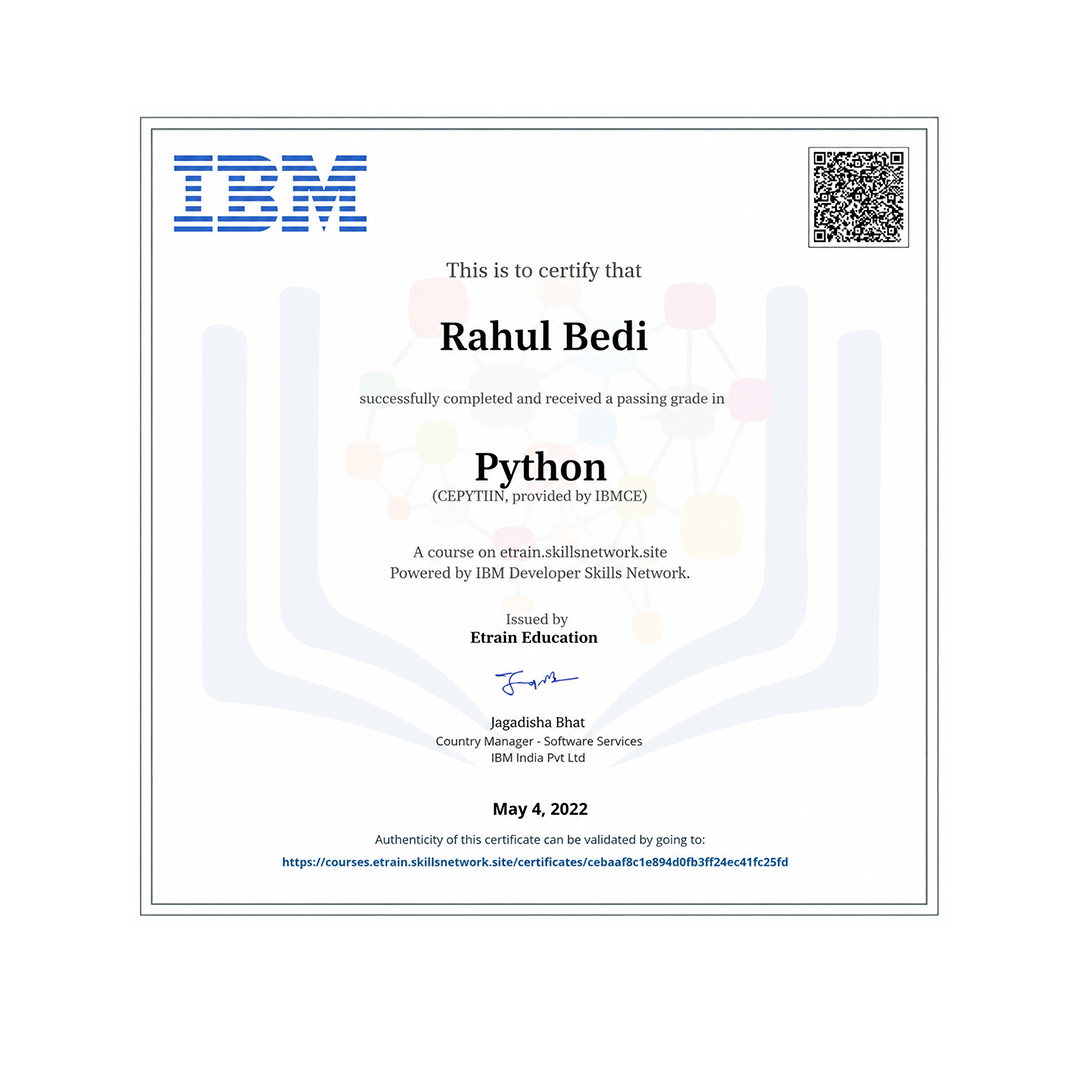
Earn professional technology certifications from leading organizations such as IBM, CCNA, and META to validate your skills and strengthen your profile.

Advantages of Globally Recognized Certifications

Globally recognized certifications validate your skills, boost credibility, and improve career opportunities worldwide.

Listen to Our Students' Video Testimonials

Data Science Course Syllabus

  • Introduction to Data Analytics
  • Introduction to Business Analytics
  • Understanding Business Applications
  • Data types and data Models
  • Type of Business Analytics
  • Evolution of Analytics
  • Data Science Components
  • Data Scientist Skillset
  • Univariate Data Analysis
  • Introduction to Sampling
  • Introduction to R programming
  • Types of Objects in R
  • Naming standards in R
  • Creating Objects in R
  • Data Structure in R
  • Matrix, Data Frame, String, Vectors
  • Understanding Vectors & Data input in R
  • Lists, Data Elements
  • Creating Data Files using R
  • Basic Operations in R – Expressions, Constant Values, Arithmetic, Function Calls, Symbols
  • Sub-setting Data
  • Selecting (Keeping) Variables
  • Excluding (Dropping) Variables
  • Selecting Observations and Selection using Subset Function
  • Merging Data
  • Sorting Data
  • Adding Rows
  • Visualization using R
  • Data Type Conversion
  • Built-In Numeric Functions
  • Built-In Character Functions
  • User Built Functions
  • Control Structures
  • Loop Functions
  • Basic Statistics
  • Measure of central tendency
  • Types of Distributions
  • Anova
  • F-Test
  • Central Limit Theorem & applications
  • Types of variables
  • Relationships between variables
  • Central Tendency
  • Measures of Central Tendency
  • Kurtosis
  • Skewness
  • Arithmetic Mean / Average
  • Merits & Demerits of Arithmetic Mean
  • Mode, Merits & Demerits of Mode
  • Median, Merits & Demerits of Median
  • Range
  • Concept of Quantiles, Quartiles, percentile
  • Standard Deviation
  • Variance
  • Calculate Variance
  • Covariance
  • Correlation
  • Hypothesis Testing
  • Multiple Linear Regression
  • Logistic Regression
  • Market Basket Analysis
  • Clustering (Hierarchical Clustering & K-means Clustering)
  • Classification (Decision Trees)
  • Time Series Analysis (Simple Moving Average, Exponential smoothing, ARIMA+)
  • Standard Normal Distribution
  • Normal Distribution
  • Geometric Distribution
  • Poisson Distribution
  • Binomial Distribution
  • Parameters vs. Statistics
  • Probability Mass Function
  • Random Variable
  • Conditional Probability and Independence
  • Unions and Intersections
  • Finding Probability of dataset
  • Probability Terminology
  • Probability Distributions
  • Bubble Chart
  • Sparklines
  • Waterfall chart
  • Box Plot
  • Line Charts
  • Frequency Chart
  • Bimodal & Multimodal Histograms
  • Histograms
  • Scatter Plot
  • Pie Chart
  • Bar Graph
  • Line Graph
  • Overview & Terminologies
  • What is Machine Learning?
  • Why Learn?
  • When is Learning required?
  • Data Mining
  • Application Areas and Roles
  • Types of Machine Learning
  • Supervised Learning
  • Unsupervised Learning
  • Reinforcement learning

Steps in developing a Machine Learning application

  • Key tasks of Machine Learning
  • Modelling Terminologies
  • Learning a Class from Examples
  • Probability and Inference
  • PAC (Probably Approximately Correct) Learning
  • Noise
  • Noise and Model Complexity
  • Triple Trade-Off
  • Association Rules
  • Association Measures
  • Concept of Regression
  • Best Fitting line
  • Simple Linear Regression
  • Building regression models using excel
  • Coefficient of determination (R- Squared)
  • Multiple Linear Regression
  • Assumptions of Linear Regression
  • Variable transformation
  • Reading coefficients in MLR
  • Multicollinearity
  • VIF
  • Methods of building Linear regression model in R
  • Model validation techniques
  • Cooks Distance
  • Q-Q Plot
  • Durbin- Watson Test
  • Kolmogorov-Smirnof Test
  • Homoskedasticity of error terms
  • Logistic Regression
  • Applications of logistic regression
  • Concept of odds
  • Concept of Odds Ratio
  • Derivation of logistic regression equation
  • Interpretation of logistic regression output
  • Model building for logistic regression
  • Model validations
  • Confusion Matrix
  • Concept of ROC/AOC Curve
  • KS Test
  • Applications of Market Basket Analysis
  • What is association Rules
  • Overview of Apriori algorithm
  • Key terminologies in MBA
  • Support
  • Confidence
  • Lift
  • Model building for MBA
  • Transforming sales data to suit MBA
  • MBA Rule selection
  • Ensemble modelling applications using MBA
  • Model building using ARIMA, ARIMAX, SARIMAX
  • Data De-trending & data differencing
  • KPSS Test
  • Dickey Fuller Test
  • Concept of stationarity
  • Model building using exponential smoothing
  • Model building using simple moving average
  • Time series analysis techniques
  • Components of time series
  • Prerequisites for time series analysis
  • Concept of Time series data
  • Applications of Forecasting
  • Understanding the Concept
  • Internal decision nodes
  • Terminal leaves.
  • Tree induction: Construction of the tree
  • Classification Trees
  • Entropy
  • Selecting Attribute
  • Information Gain
  • Partially learned tree
  • Overfitting
  • Causes for over fitting
  • Overfitting Prevention (Pruning) Methods
  • Reduced Error Pruning
  • Decision trees – Advantages & Drawbacks
  • Ensemble Models
  • Parametric Methods Recap
  • Clustering
  • Direct Clustering Method
  • Mixture densities
  • Classes v/s Clusters
  • Hierarchical Clustering
  • Dendogram interpretation
  • Non-Hierarchical Clustering
  • K-Means
  • Distance Metrics
  • K-Means Algorithm
  • K-Means Objective
  • Color Quantization
  • Vector Quantization
  • Tableau Introduction
  • Data connection to Tableau
  • Calculated fields, hierarchy, parameters, sets, groups in Tableau
  • Various visualizations Techniques in Tableau
  • Map based visualization using Tableau
  • Reference Lines
  • Adding Totals, sub totals, Captions
  • Advanced Formatting Options
  • Using Combined Field
  • Show Filter & Use various filter options
  • Data Sorting
  • Create Combined Field
  • Table Calculations
  • Creating Tableau Dashboard
  • Action Filters
  • Creating Story using Tableau
  • Clustering using Tableau
  • Time series analysis using Tableau
  • Simple Linear Regression using Tableau
  • Integrating R code with Tableau
  • Creating statistical model with dynamic inputs
  • Visualizing R output in Tableau
  • Case Study 1- Real time project with Twitter Data Analytics
  • Case Study 2- Real time project with Google Finance
  • Case Study 3- Real time project with IMDB Website

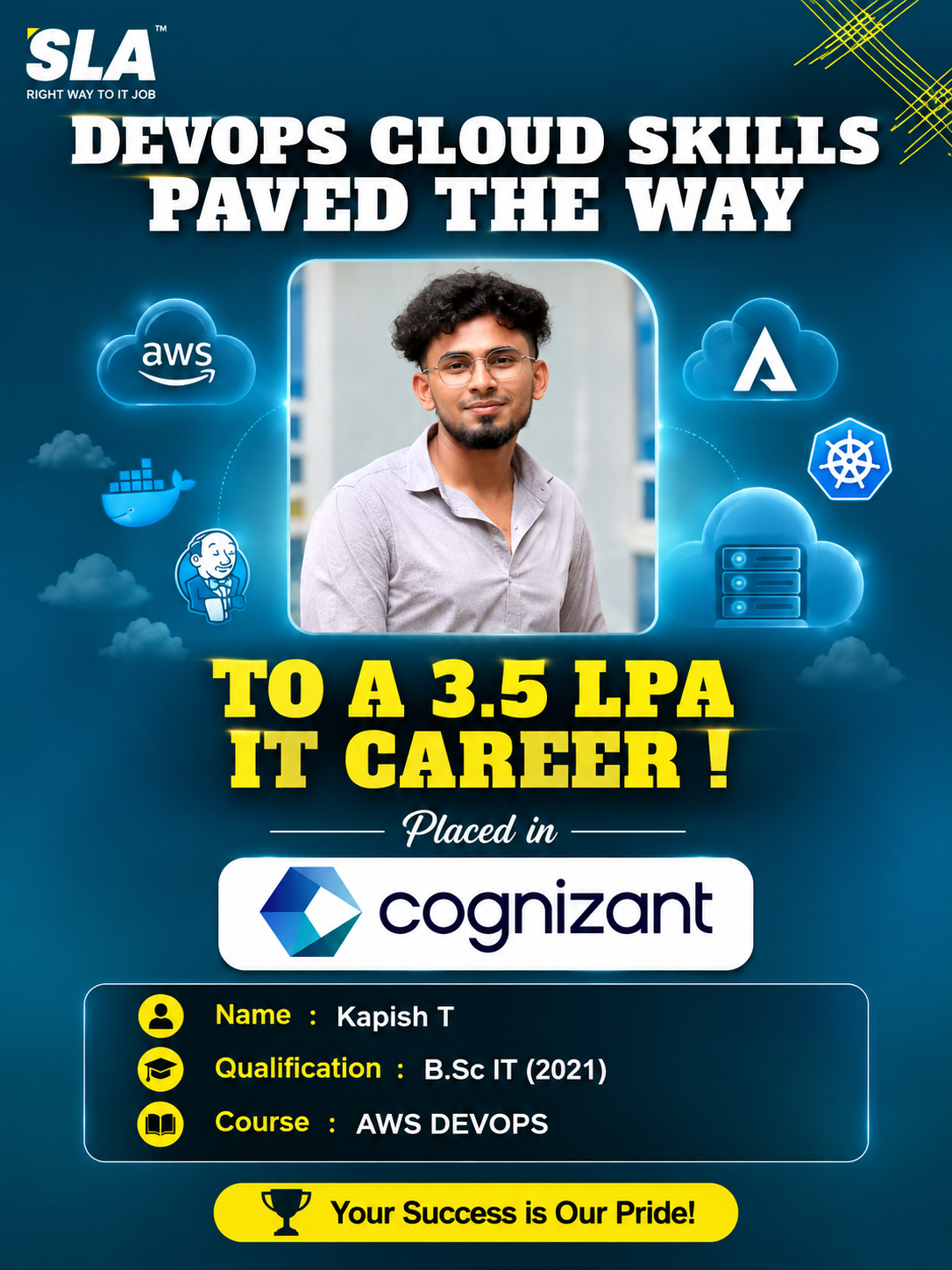
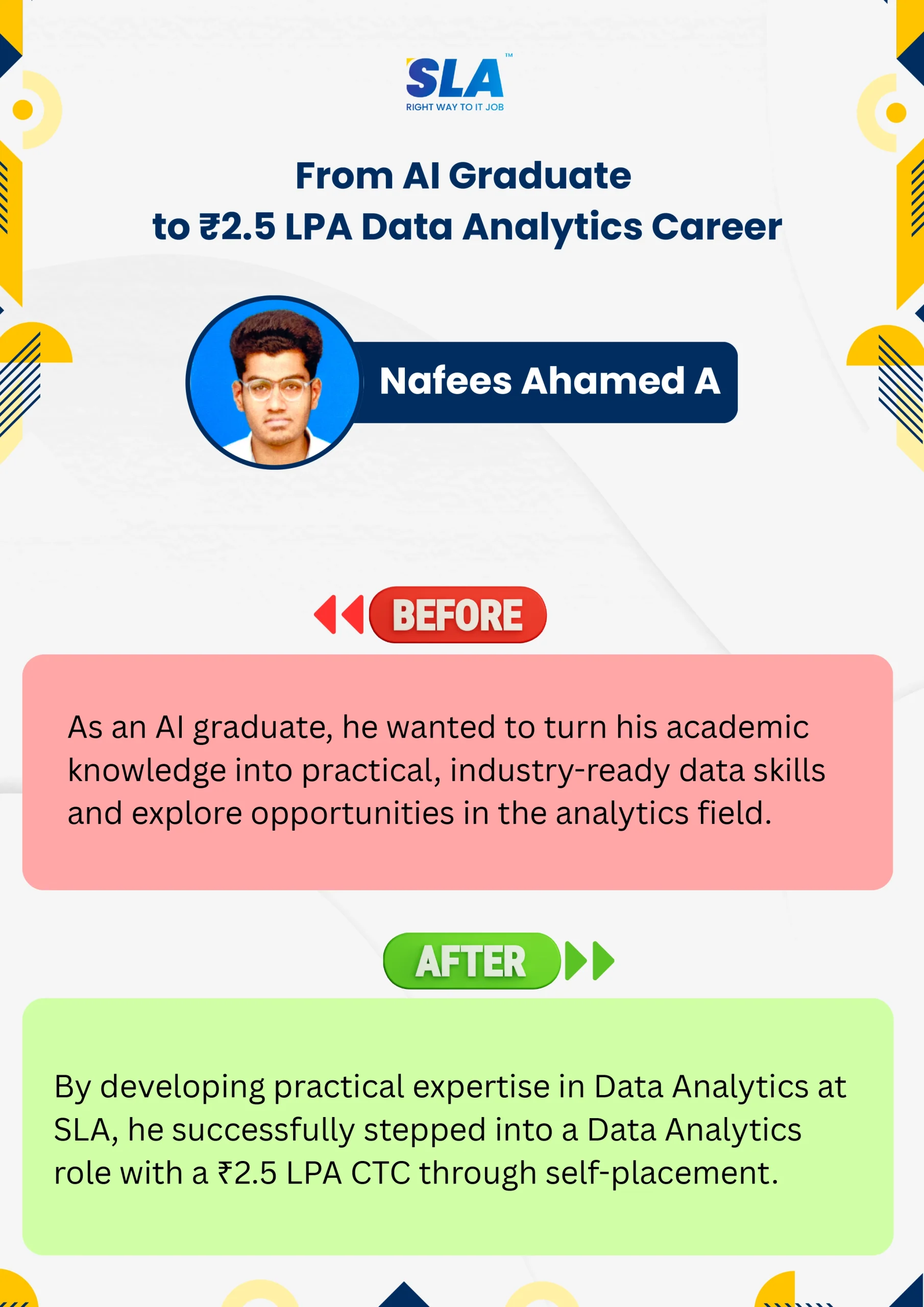
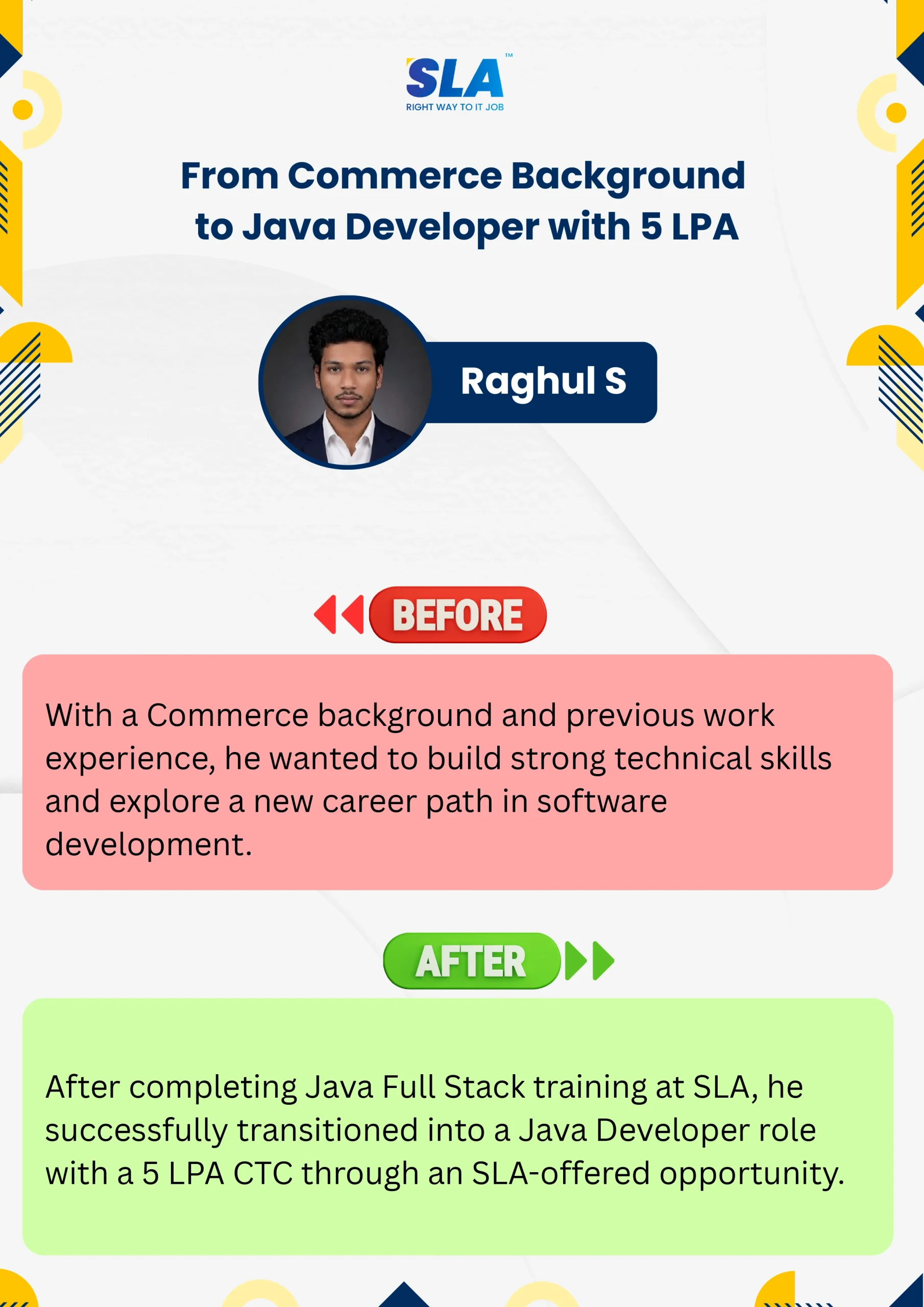
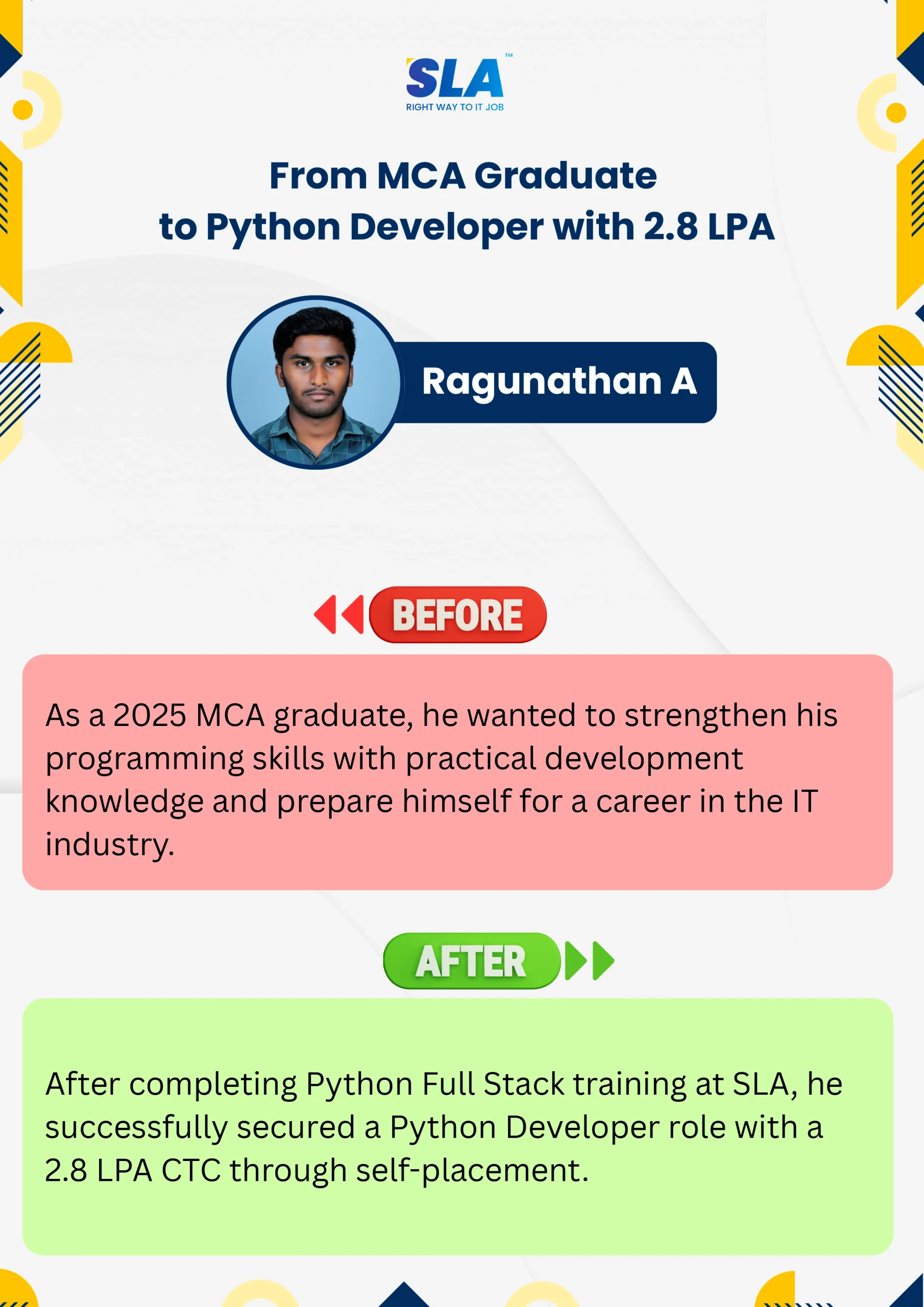
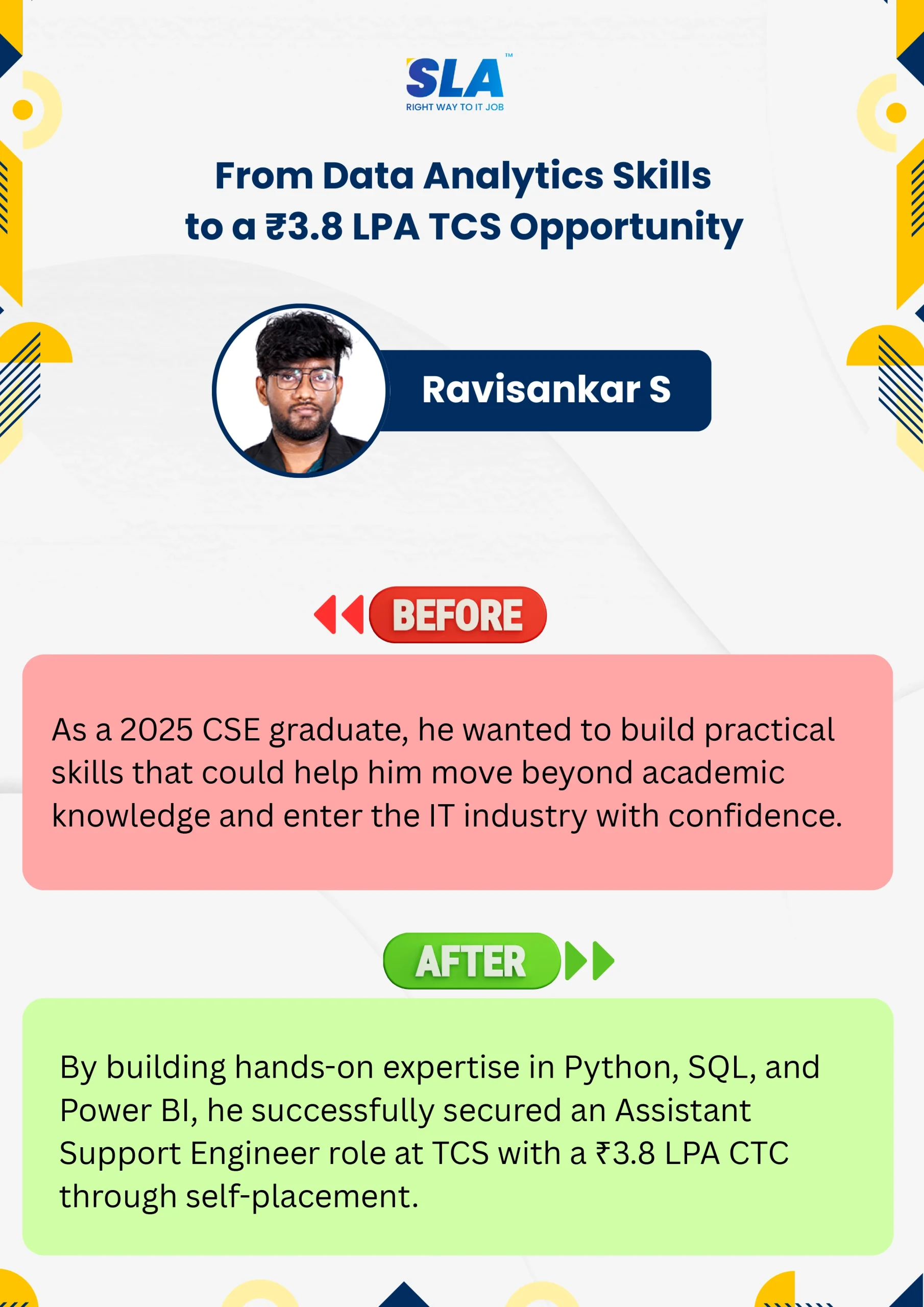
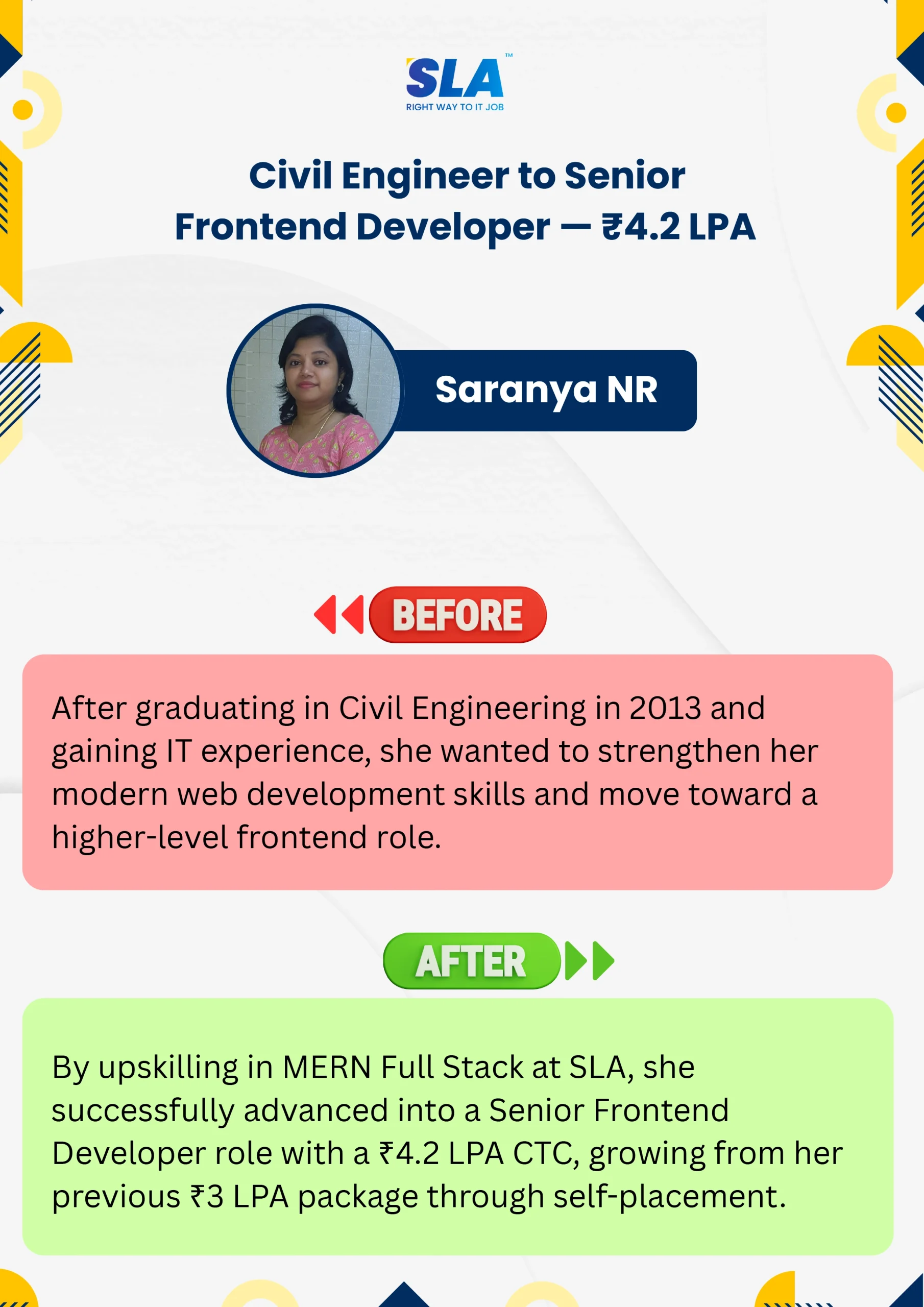
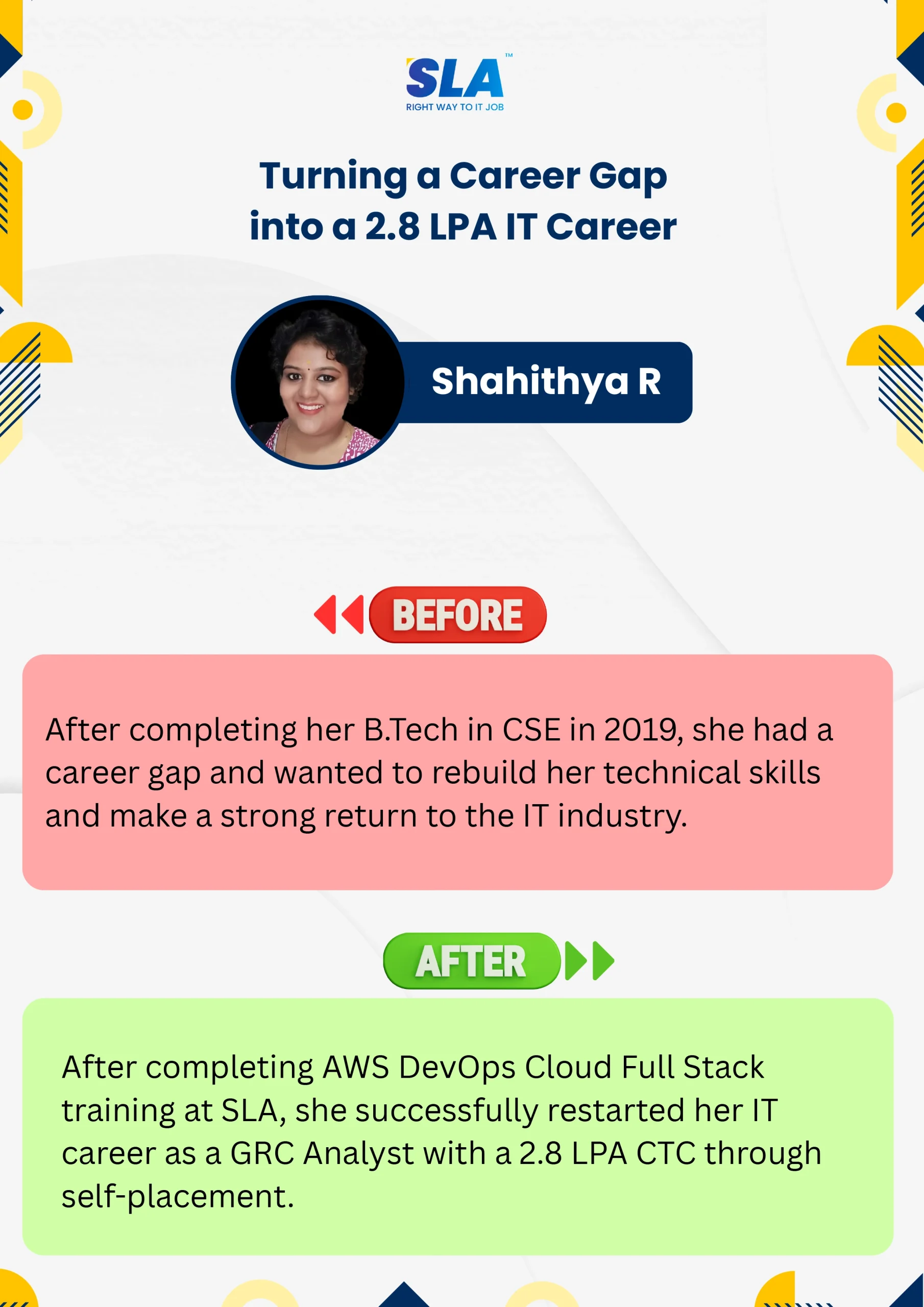
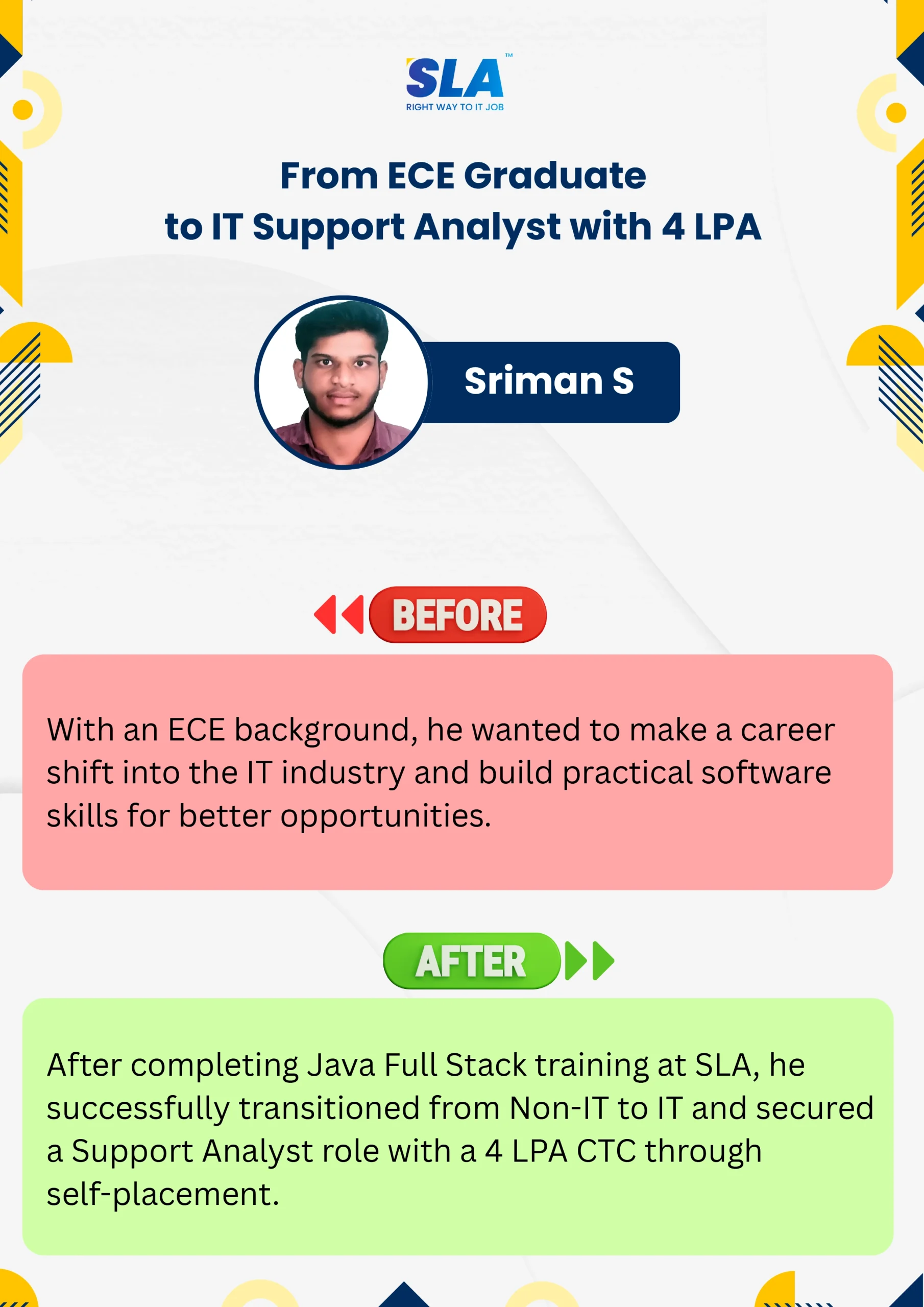
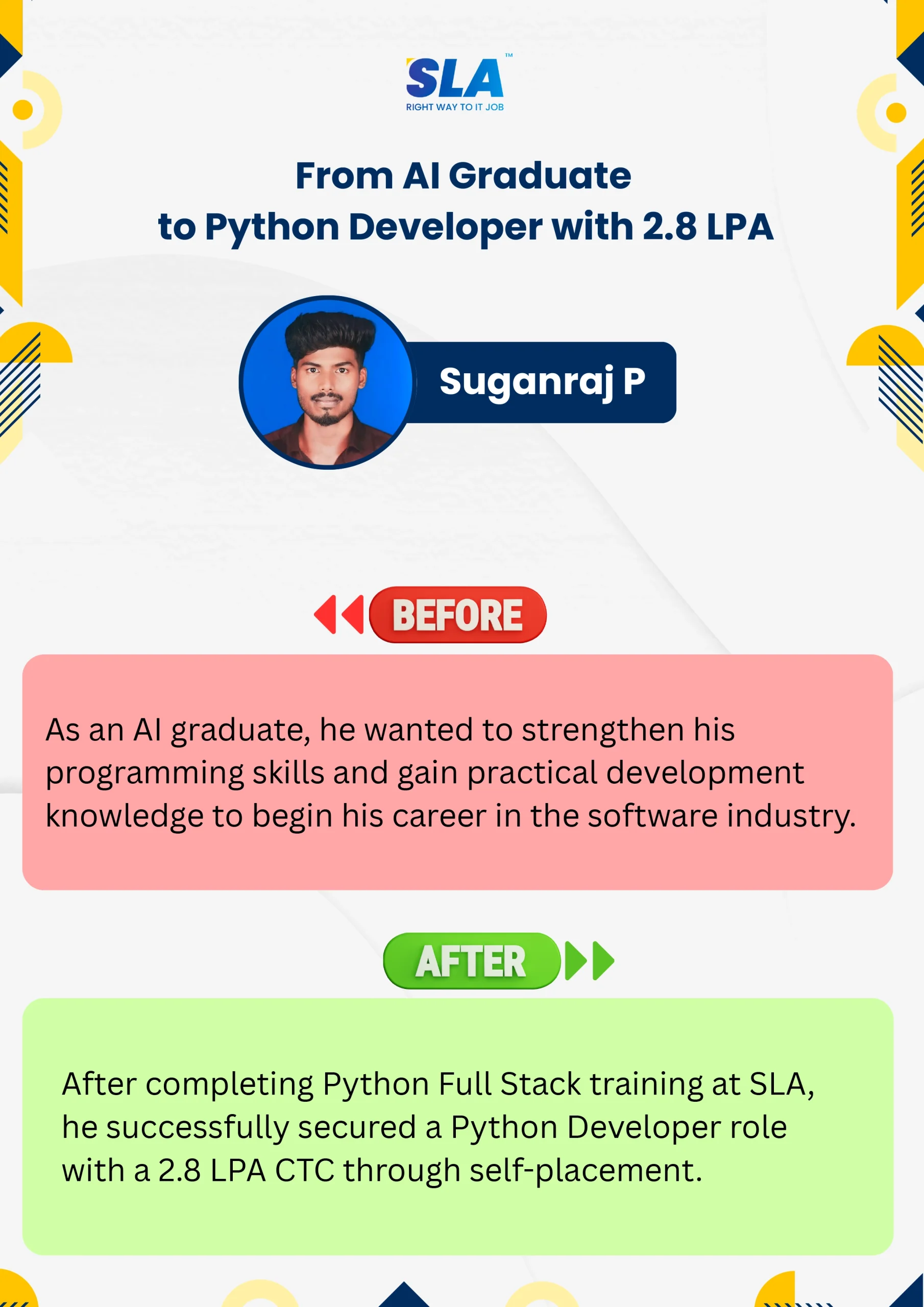
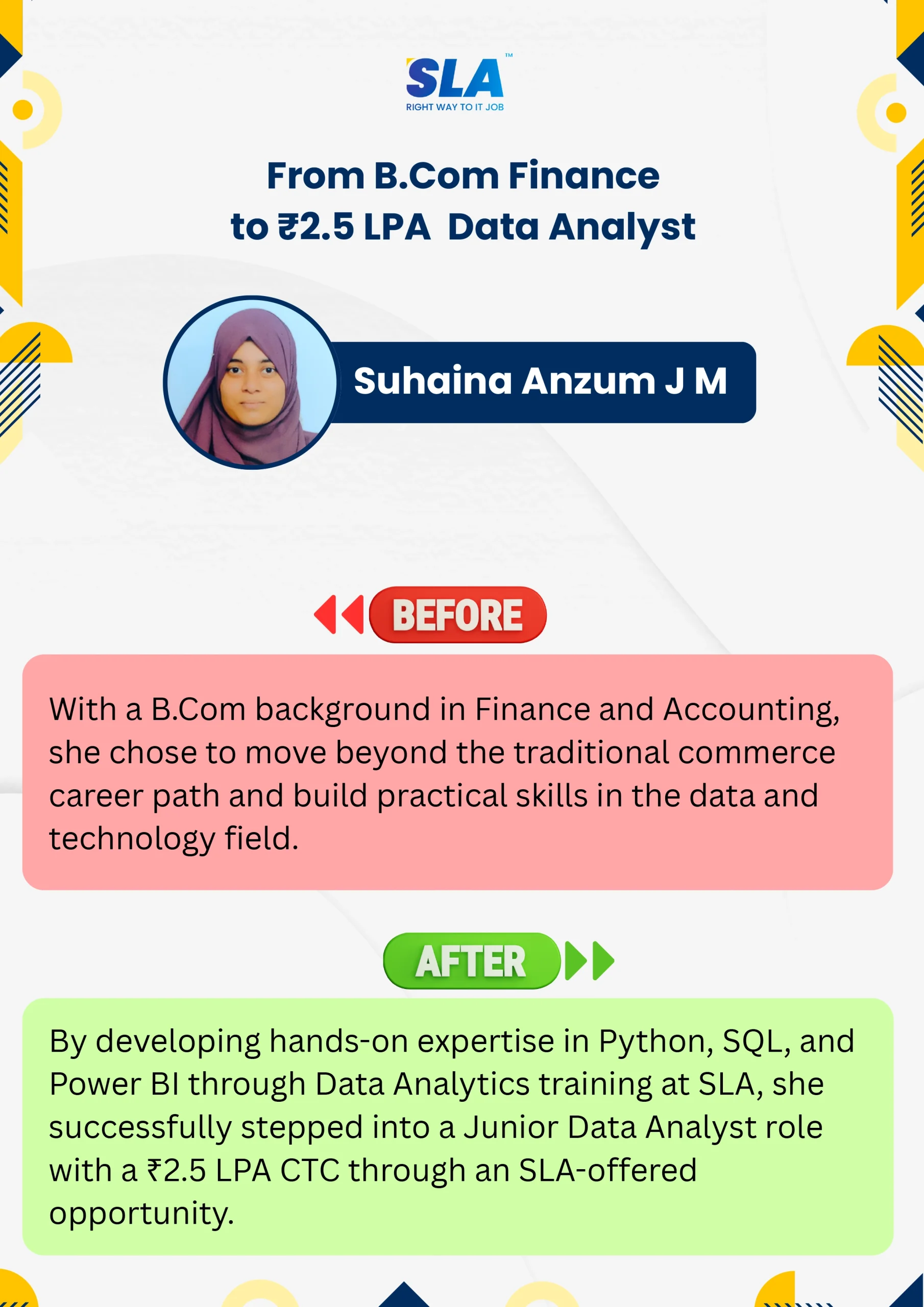
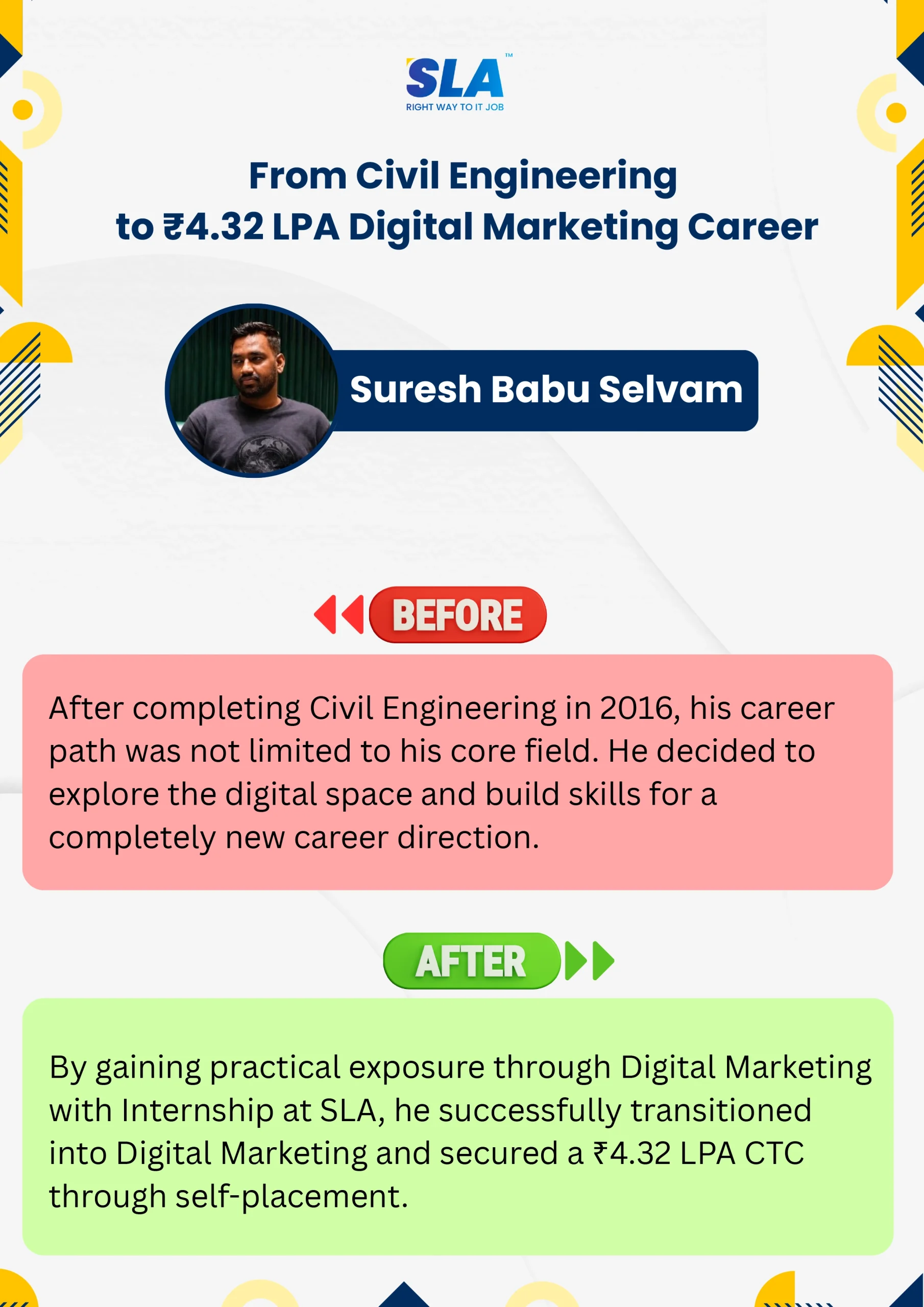
Life Changing Stories

See More Success Stories

Upcoming Batches

Hands On Training
3-5 Real Time Projects
60-100 Practical Assignments
3+ Assessments / Mock Interviews
November 2026
Week days
(Mon-Fri)
Online/Offline

2 Hours Real Time Interactive Technical Training

1 Hour Aptitude

1 Hour Communication & Soft Skills

(Suitable for Fresh Jobseekers / Non IT to IT transition)

Course Fee
November 2026
Week ends
(Sat-Sun)
Online/Offline

4 Hours Real Time Interactive Technical Training

(Suitable for working IT Professionals)

Course Fee

Save up to 20% in your Course Fee on our Job Seeker Course Series

Learn More

Students Placed in TOP MNCs in India

3D Coverflow Carousel
Review Image
View Placed Students List
The SLA Way to Get Placed

The SLA Way to Get Placed

Seven connected stages, one continuous path from enrollment to your career launch — here is exactly how it works, step by step.

01
🎓

Technical Mastery

Industry-aligned curriculum, daily coding tasks, real-time projects.

02
💻

Career Readiness

Aptitude, communication, ATS-friendly resume optimization.

03
🎯

Placement Prep

Aptitude, communication tuning and technical interview mastery.

04
💬

Panel Mock Interviews

Real company-pattern mocks with expert panel feedback.

05
👨‍💼

Interview Schedule

Multiple company drives with lifetime placement support.

06
📝

Interview Feedback

Detailed performance analysis and one-on-one guidance.

07
🏆

Launch Your Career

Land your first job with lifetime alumni and career support.

Know the process

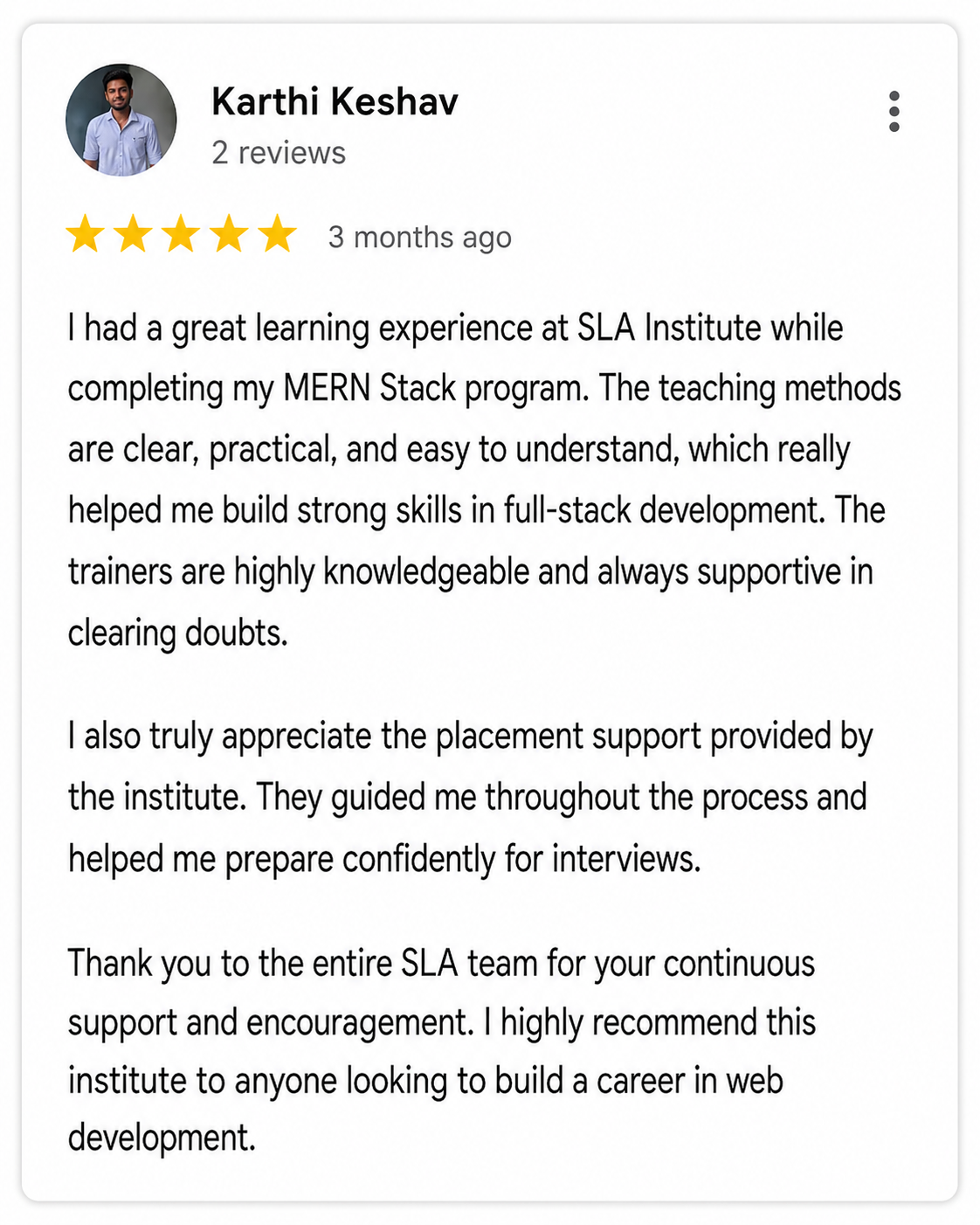
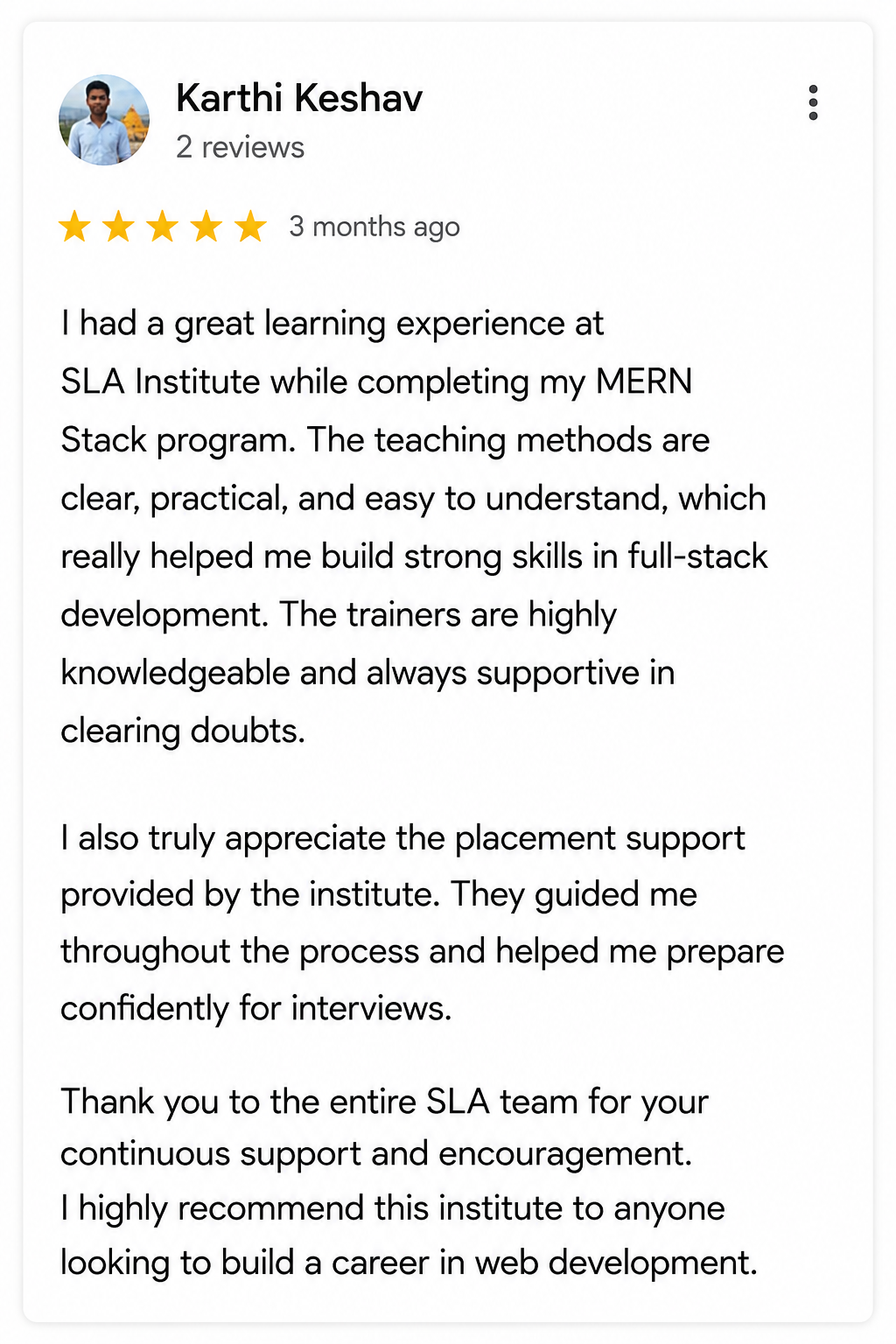
Check our Google Reviews

3D Review Carousel

Just a minute!

If you have any questions that you did not find answers for, our counsellors are here to answer them. You can get all your queries answered before deciding to join SLA and move your career forward.

We are excited to get started with you

Give us your information and we will arange for a free call (at your convenience) with one of our counsellors. You can get all your queries answered before deciding to join SLA and move your career forward.