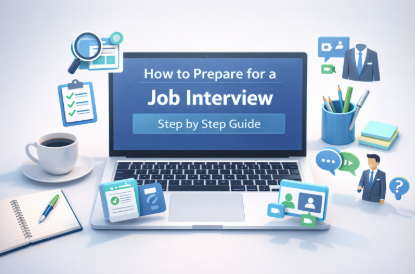
Preparing for a job interview often feels stressful. You may constantly worry about what the interviewer will ask or whether you will be able to give satisfactory answers.
A lot of candidates walk in with good skills but with poor preparation. In many cases, the level of preparation becomes the deciding factor between getting hired and getting rejected.
A job interview is a conversation between you and the interviewer to see if you are the right fit for the job role. It is your chance to show how well you fit the company culture.
However, you need to be prepared well to present yourself with clarity and confidence. But how can you prepare in a structured way? This is what I’ll help you learn in this blog.
Step-by-Step Guide to Prepare for a Job Interview
The following is the complete preparation guide for the job interview:
Read the Job Description Carefully
The first step in interview preparation is to read the job description thoroughly. Pay attention to the required skills, qualifications, and responsibilities.
Check for both the hard and soft skills.
- Hard skills usually include your technical abilities or certifications
- Soft skills often include teamwork and communication
Make a list of your experiences that relate to the job post. This helps you highlight the experiences in your resume that match the role. If the job description mentions specific processes, refresh your knowledge about them. This will help you speak confidently about your experience.
Research the Company
Before walking into an interview, take some time to research the company. Visit their website to learn about their projects, mission, and services.
You can visit their profiles on LinkedIn and Glassdoor to get more information about them. These platforms also include employee experiences and interview patterns. This can give you better insights, like the company reviews and salary ranges.
Researching the organization helps you to prepare your answers beforehand, such as “Why do you want to work here?” It also helps you come up with relevant questions to ask the interviewer to show your interest in the role.
Practice Commonly Asked Questions
Many interviews include behavioural questions to learn how you manage different circumstances. These types of questions often begin with broad statements such as “tell me about a time when…”. Through them, employers learn how you handle stress and interact with team members.
Thus, if you are asked a behavioural question, avoid a random response. Instead, use a simple structured approach like the STAR method. The simple explanation of its components is:
Situation – Describe the context or background of the event
Task – Explain the responsibility or challenge you were given
Action – Share the specific steps you took to handle the situation
Result – Explain what you achieved
The approach lets you structure your responses. You can alternatively practice responding to common questions with a friend or mentor. The common questions may include:
- Give me additional details about yourself
- Why should we choose you?
- In five years, where do you see yourself?
You may reduce interview anxiety and improve clarity by practicing these questions.
Get Ready According to the Interview Type
Verify the kind of interview so you may get ready accordingly. It can be an online or in-person interview. Both call for a different approach.
Check your microphone, camera, and internet connection if the interview is conducted online. Choose a place with adequate illumination. Keep your background clean as well. For online interviews, commonly used platforms are Zoom, Google Meet, or Microsoft Teams.
For panel interviews, try to maintain eye contact with each person. This shows you respect and acknowledge everyone in the room.
Review Your Resume and Supporting Documents
You have to be fully familiar with your own documents. Avoid writing anything for which you cannot offer a convincing justification. If you have added any achievements, be prepared to provide more details about them. Also, get ready to justify any employment gaps.
Edit your resume depending on the position. Some businesses employ an applicant tracking system for online applicants. This system scans and filters resumes according to keywords. Your chances of getting noticed increase when your resume includes relevant keywords and is matched with the position.
Strengthen Your Knowledge
Prepare the main concepts related to the job role. Go through the key topics and the processes mentioned in the job description.
Read documents and articles to improve your knowledge and make concise notes to review the keypoints before appearing for an interview. However, reading long articles can sometimes feel time-consuming and hectic.
To save time and energy, you can paste the lengthy content into AI Text Summarizer to quickly extract the keypoints. It shortens large sections of text into clear points, making it easier to revisit the information before the interview.
Work on Body Language and Communication
You may have already heard that first impressions matter. Your body language speaks a lot before you say a single word. So, maintain eye contact with the interviewer and sit upright.
Avoid crossing your arms as it can make you seem unapproachable. Avoid looking at your phone and speak at a steady pace. Take short pauses before answering, and don’t answer abruptly.
Good communication is not about speaking fast. It is about speaking with clarity and confidence.
Ask Questions from the Interviewer
At the end of the interview, the interviewer might ask you if you have any questions. Always say yes. You can ask about the performance expectations and the team structure. For instance:
- What does success look like in this role?
- How do you measure performance?
- What are the next steps?
When you ask thoughtful questions, it makes you seem interested.
Summing Up
Many candidates feel overwhelmed before entering an interview. This interview stress can become easier to manage when you are properly prepared.
Research the company. Learn about their past projects. Study the key responsibilities. When you enter the interview with proper preparation, you may perform better.
I’ve mentioned the most essential steps to prepare for the interview. Review them carefully and give yourself the best possible chance to succeed in your next job interview.