
Introduction
In the highly fast-paced corporate environment we live in today, conventional management is dead, and Agile reigns supreme as the key mechanism behind successful enterprises. For anyone who wants to stop running after deadlines and start developing valuable products flawlessly and clinically, this tutorial is your perfect starting point. Agile is more than a framework; it is a mindset that empowers multi-disciplinary teams to develop better software, reduce risks on projects, and create extraordinary value in record time.
Looking to transform from chaos to excellence and secure top-paid leadership positions? Click here to download our comprehensive Agile Methodology Course Syllabus now and learn the frameworks used by the world’s best technology companies!
Agile Methodology Tutorial for Beginners
Think about developing a contemporary smartphone application using a plan drafted two years prior, but without exposing it to any users until the day of its release. By the time you do so, the preferences of the user have changed, the competing markets have launched newer features, and the plan has become utterly outdated.
This inflexible, sequential process is referred to as the Waterfall methodology. For many decades, this method has been used for project management: planning, designing, development, testing, and releasing. However, in an era of rapid economic growth driven by technology, Waterfall often results in late deliveries, increased costs, and unpopular products.
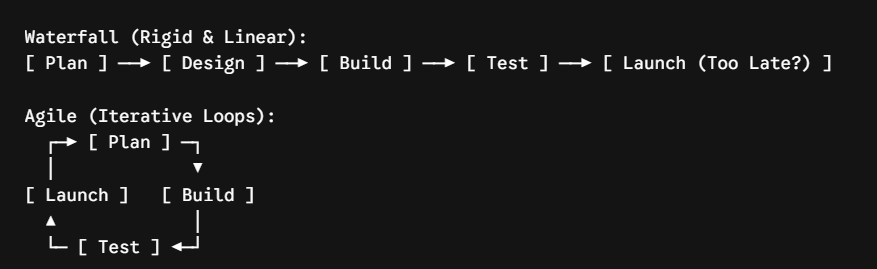
Agile Methodology literally turns this idea on its head. Rather than placing all of your chips on one large and dangerous release, Agile decomposes the large project into small, bite-sized pieces. You create a small functional piece, test it with actual users, collect feedback, and adjust your strategy accordingly.
In this Agile Tutorial for Beginners, you will learn how the world’s best tech teams perform projects through the use of the Agile methodology.
1. The Core Philosophy – Agile Manifesto
Agile is not a piece of software or a list of hard-and-fast rules. Agile is a way of thinking. In the year 2001, a meeting was held by seventeen experts in software development in Utah who were searching for an alternative to traditional software development processes that had too many documents. Thus, they drafted the Agile Manifesto, consisting of four core values and twelve principles.
| We Value This More… | …Than This |
| Individuals and interactions | Processes and tools |
| Working software | Comprehensive documentation |
| Customer collaboration | Contract negotiation |
| Responding to change | Following a plan |
Big Myth: This doesn’t imply that documentation, tools, and planning are not important at all; it implies that in case there’s a conflict, a winning team gives priority to working software and collaboration over documentation strictly.
2. The Scrum Model: The Driving Force of Agile
Whereas Agile is the general ideology, Scrum is a very structured and concrete model, adopted by more than 80% of Agile teams to apply Agile. Scrum divides the work process into fixed blocks of time (Sprints, ranging from 1 to 4 weeks), during which the team concentrates on delivering a certain piece of software.
The Three Main Principles of Scrum
- Transparency: Everything related to the process has to be visible to those who are responsible for its results. No blockers or bugs hiding.
- Inspection: Scrum practitioners need to inspect the product and the process on a regular basis to spot any undesirable deviations.
- Adaptation: In case a process or a quality issue is identified, the team changes its direction right away.
Roles in a Scrum Team
The typical Scrum team is small and cross-functional, as well as self-organizing (with 5 to 9 members). It consists of exactly three types of roles:
- Product Owner (PO): The customer’s representative. The PO owns “What.” They oversee the Product Backlog (a complete set of requirements), make sure that each task is prioritized by its business value, and make sure that the team develops the proper product.
- Scrum Master: The coach for the team. They own “How.” They don’t manage anyone or give any commands, but remove blockers and help in running meetings in the correct way.
- The Developers/Development Team: The specialists who develop the product. This role involves software developers, designers, and QA specialists. They are fully independent in selecting ways to implement backlog items.
3. Visual Work Process: The Kanban Methodology
Yet another extremely popular Agile methodology is Kanban, which is Japanese for “visual sign” or “billboard.” It was developed by Toyota for production optimization purposes. In contrast to Scrum’s sprints, Kanban emphasizes a continuous and fluid work process.
Kanban Board
Visualization is a key component of the Kanban method. Here’s what the traditional entry-level Kanban board looks like:
| Backlog | To Do | In Progress | Testing / QA | Done |
| Feature: Dark Mode | User Story: Set up Login UI | User Story: Password Reset API | User Story: Database Migration | User Story: Social Login OAuth |
| Feature: PDF Invoice | User Story: Update Profile Pic | Bug #402: Fix CSS alignment |
Bug #405: Footer Link
Kanban’s WIP Limits: The Secret Behind Its Effectiveness
The single most important aspect of Kanban is WIP (Work-In-Progress) Limits. You impose an absolute cap on how many cards can be in a particular column at once.
If your “In Progress” column has a WIP limit of 2, then your team is not allowed to pull any new cards into that column until one of those tasks is moved to “Testing/QA” successfully.
How WIP Limits work: They immediately show you bottlenecks. If there’s too much work in testing, everyone in the development team stops what they’re doing and helps get the tests done. Learn deeper with our Agile Challenges and Solutions.
4. Agile Requirements: Epics, User Stories, and Tasks
Requirements in project management are documented in large, 200-page Functional Specifications Documents. In Agile, on the other hand, requirements are decomposed into small, user-oriented chunks.
[ Epic: Global Search Functionality ] │ ├──► [ User Story A: Search by Product Name ] ──► (Task: DB Query, Task: UI Input) │ └──► [ User Story B: Filter by Price Range ] ──► (Task: Slider Component)
Hierarchy
- Epic: Big Business Objectives, which is not possible in one sprint and requires many sprints (e.g., “Create an e-commerce checkout system”).
- User Story: Small Feature from the point of view of the user. It can easily fit within one sprint.
- Task: Detailed technical steps for the development of that small user story.
Creating Perfect User Stories
To guarantee that the development team understands the value of implementing a new feature for the business, the Agile experts use a template to create user stories:
As a [type of user], I want to [perform an action], so that [achieve a specific benefit]
For instance:
- As a returning customer,
- I want to save my credit card information securely,
- So that I can check out within ten seconds on future visits.
Acceptance Criteria: Definition of “Done”
Each user story requires clear acceptance criteria. This is a set of requirements that should be fulfilled for the feature to be approved by the Product Owner. Here is an example of how acceptance criteria can be stated using behavioral conditions:
- Given the user is on the payment page,
- When they enter a valid card and select “Save Card”,
- Then the system must encrypt the data and show a confirmation badge “Card saved successfully”.
5. Agile Estimations: Story Points and Planning Poker
The traditional manager would say: “How many hours do you think this feature will take?” While we understand as technologists that time estimations for creative work done in software development are notoriously difficult, Agile estimation is made based on Story Points that show the complexity and risk of a particular task.
The Fibonacci Sequence
Team members assign points in the following way using the modified Fibonacci sequence: 1, 2, 3, 5, 8, 13, 20.
- A 1-point story means a very easy story (for instance, just change the text on a button).
- An 8-point story means a complex story with structural unknowns.
- A 20-point story means an enormous story that should be broken down before developing.
Planning Poker Procedure
To prevent group thinking, team members use a game called “Planning Poker”:
- The product owner provides a user story.
- Each developer takes his/her virtual card, which represents the number of points they believe (e.g., 3, 5, 8).
- All team members open their cards at the same time.
- If one finds a big difference between the estimates (one developer chose 2, another chose 13), the outliers provide their explanations, and the team discusses and then revisits their votes.
Explore Agile Project Ideas and get expertise.
6. Technical Implementation of Agile Execution: Automated Metrics Tracking
Today, efficient Agile development relies on real-time metrics tracking. Velocity is the ultimate metric of a team’s performance in Scrum—a sum of story points completed by the team during one sprint.
The following is the Python-based automated implementation of Agile Sprint Performance Tracker that measures team velocity, identifies over-committed teams, and detects problems that need changes in structure.
def analyze_sprint_metrics(sprint_data):
“””
Analyzes core Agile sprint performance data.
Evaluates team velocity, commitment ratios, and identifies story bloating.
“””
print(“=== AGILE TEAM PERFORMANCE MATRIX ===”)
total_committed_points = 0
total_completed_points = 0
bloated_stories_count = 0
# Process each story card inside the sprint backlog array
for story in sprint_data:
points = story[“story_points”]
total_committed_points += points
if story[“status”] == “Done”:
total_completed_points += points
# Stories rated 13 points or above are considered too complex (bloated)
if points >= 13:
bloated_stories_count += 1
print(f”[WARNING] Bloated Story Detected: ‘{story[‘title’]}’ is ({points} pts). Split it into smaller chunks!”)
# Calculate Velocity and Commitment Fulfillment Ratio
velocity = total_completed_points
completion_rate = (total_completed_points / total_committed_points) * 100 if total_committed_points > 0 else 0
print(“-” * 40)
print(f”Sprint Velocity (Points Delivered): {velocity}”)
print(f”Commitment Completion Rate : {completion_rate:.1f}%”)
# Structural health diagnostic assessments
if completion_rate < 80:
print(“[ACTION REQUIRED] Team over-committed. Reduce planned points for the next Sprint cycle.”)
elif completion_rate > 100:
print(“[DIAGNOSTIC] Velocity exceeds commitment. Team pulled in extra backlog cards mid-sprint.”)
else:
print(“[HEALTHY] Excellent predictability! Team delivered matching commitment parameters.”)
return {“velocity”: velocity, “completion_rate”: completion_rate}
# Simulated dataset representing a live Scrum Sprint Backlog
current_sprint_backlog = [
{“id”: “US-101”, “title”: “Setup User Authentication Flow”, “story_points”: 5, “status”: “Done”},
{“id”: “US-102”, “title”: “Build Global Search Microservice”, “story_points”: 13, “status”: “In Progress”},
{“id”: “US-103”, “title”: “Design Corporate Brand Footer UI”, “story_points”: 2, “status”: “Done”},
{“id”: “US-104”, “title”: “Integrate Razorpay Gateway API”, “story_points”: 8, “status”: “Done”},
{“id”: “US-105”, “title”: “Fix Profile Picture Layout Bug”, “story_points”: 3, “status”: “To Do”}
]
# Run production script evaluation
sprint_results = analyze_sprint_metrics(current_sprint_backlog)
7. The Standard Agile Template
To have structural consistency in software product lifecycles, Agile follows the standard operational cycles. This template provides a roadmap for the development of a project.
[ Product Vision Blueprint ]
│
▼
[ Product Backlog Refinement ] ──► (PO prioritizes User Stories continually)
│
▼
[ Sprint Planning Assembly ] ──► (Team commits to a 2-week chunk of work)
│
▼
[ Daily Standup Touchpoints ] ──► (15-min sync: Done yesterday, doing today, blockers)
│
▼
[ Sprint Review Showcase ] ──► (Live demonstration of working software to clients)
│
▼
[ Sprint Retrospective Loop ] ──► (Internal deep-dive: How can we improve processes?)
You can now rid yourself of systematic engineering waste, significantly lower the risk associated with product development and delivery, and set velocity goals that can be achieved consistently.
Enroll in our Agile Course in Chennai today for a bright career.
Conclusion
At this point, you have discovered the core principle of Agile project management. By taking the step to look away from rigid, years-long planning and adopt iteration, cross-functional teams, visual Kanban boards, and rapid feedback loops, you have just obtained a blueprint to run projects with great accuracy in the tech world.
Agile is all about doing things better and more efficiently, and not working hard and fast. The principle of Agile consists of reducing waste, engaging closely with customers/users, and developing projects that meet the mark. Transitioning to Agile will not only free your projects from major setbacks but also make you a highly valuable employee for any company in the tech sector.
If you wish to gain mastery of industry-leading tools such as Jira, hold successful daily stand-ups, and work towards lucrative jobs such as Scrum Master, Product Owner, or Agile Project Manager, join our premier IT training institute in Chennai.